Re: US Erection 12 *AND* 16 *AND* 20
Posted: Mon Jun 22, 2020 6:09 am
Uhm.... are you getting your Kurd facts from Erdogan?Megaterio Llamas wrote: ↑Mon Jun 22, 2020 2:02 am
As far as the Kurds, they were always going to be abandoned, no matter the US administration. The Kurds have served as the handy henchmen for competing powers in the region for the past 500 years from the Battle of Chaldiran to the Ottoman Christian Genocide and they are always abandoned, albeit with an expended land base and anything they could plunder from their neighbors. That is simply the history of the Kurds. And as far as their claims in Syria, they are completely without merit. The Kurds came to Syria as refugees less than 100 years ago and now they are claiming lands that do not historically belong to them. They have treacherously turned on the country that gave them shelter as refugees and have thrown in with their enemies in their time of greatest vulnerability. It is despicable, and surely will never be forgotten by Syrians.

But of course, Turkey, Syria, Iran and Iraq all of course would say that the Kurdish claims are without merit.
There are some 30-45 million Kurds, depending on who is counting. They are the largest ethnic group lacking a nation of their own. They have a distinct culture, history and language. Kurdish is an Indoeuropean language, related to but distinct from Farsi (or Persian). There is mentioning of a people called Karda inhabiting the area surrounding Lake Van in Mesopotamian clay tablets dating back to 3000 BC. Whether these "Karda" are the same people as the modern Kurds is disputed, but Lake Van is situated right in the heartland of Kurdistan.
So, of course, Kurdistan is not recognised as a country, and not outlined in official maps, but here is a look at where the Kurds were the majority population in 1922, basically right after WW1 and the breakup of the Ottoman Empire:
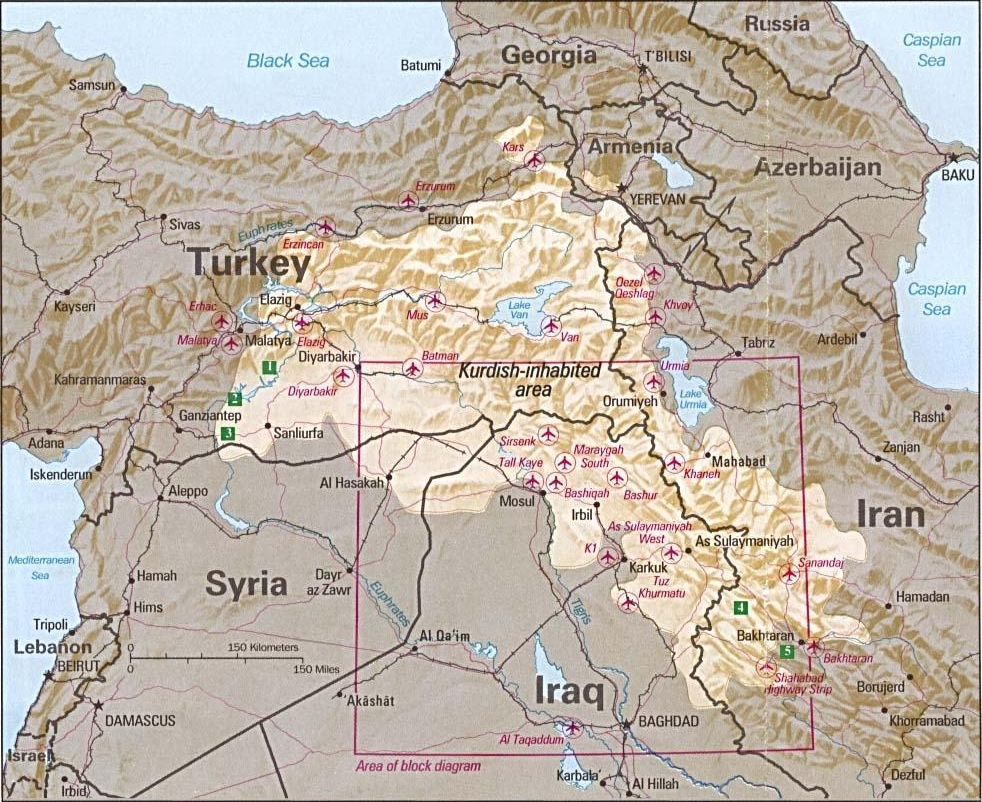
As you can see the area spans part of Turkey, Iraq, Iran and Syria. In all four countries the Kurds have been oppressed and considered second class citizens. Turkey has long even denied the existence of Kurds and has prohibited the use of the Kurdish language. It was only as they started negotiating with the EU for possible future membership that they grudgingly agreed to decriminalize the publishing of Kurdish books and newspapers and allowed for some use of the Kurdish language in local schools in Turkish Kurdistan. It's hard to say which country has treated them worst. That has varied over time, as governments come and go, and thus meant that Kurds occassionally hop the border from one of the four countries to another. This is probably what is referred to when Syrians talk about Kurdish new arrivals. Kurds as a group has been there for millennia, but Turkish Kurds, and more specifically members of the PKK (The Workers' Party of Kurdistan) have allegedly used northern Syria as a base for carrying out attacks on Turkish military.
Your idea of an expanded land base is without merit, as the Kurds have not really had any sort of independence since the days of the Ayyubids (1171-1341), a dinasty founded by Saladin (yes, he was a Kurd) and covered the green area in the map below:

After they were crushed by the Mongols, the Kurdish area was later split between the Ottoman empire and the Persians, with borders moving back and forth over the years. Then with the breakup of the Ottoman empire, the parts of Kurdistan that were not in Persia/Iran got split between Irag, Turkey and Syria, and has remained like that since. There was talk of creating a Kurdistan after WW1, but it fell through.
Now, in recent history, the Kurds in Iraq have managed a sort of semi-independence or autonomy in northern Iraq. They have their own local authorities, police, and even some sort of national guard. They do still remain part of Iraq though. The Kurds in Syria tried to opt for something similar when the civil war started there. The Syrian war started with protests against rising prices on food (some say caused by climate change related droughts) that then became even more anti-Assad after he ordered the military to fire on the protesters, killing hundreds of young civilians.
Once the war had started, Isis, that was created in Iraq as a result of the Iraq war, moved in. As they attacked the Kurds, and especially the Yazidi, who are a group of Kurds that are not Muslim (most are), the Kurds started to fight them and as they liberated more and more territory from Isis, they also saw the part of Syria under Kurdish control grow.
Well, it's a mess really, because originally the uprising in Syria was about getting rid of Assad and holding free elections, but the group that wanted that were mostly civilians and had little access to weapons, so they were easy prey for the Assad regime. But as that was going on, different jihadist groups including Isis, al Qaida and al Nusra attacked from the South and East while the Kurds in the Northeast corner and Turkmens in the Northwest tried to upper their hand to gain autonomy or independence. Assad's troop was fighting everybody and started to crumble.
Now, Assad is an Alawite, which is basically a splinter sect of Shia Islam. Like other Shia Muslims they believe Ali ibn Abi Talib was the rightful successor to Muhammad, rather than Abu Bakr, who was named caliph by a group of Muslims at Saqifah and is considered the rightful successor by the Sunni Muslims (kind of like the original church in Jerusalem, lead by Jesus's brother James had survived and continued to compete with Paul's more romanisized version of Christianity...). But unlike other Shia they drink wine, that they see as Ali's transubstantiated essence, in their rituals. Also, at the core of Alawite belief is a divine triad, comprising three aspects of the one God. So clearly some sort of Christian influence, one would assume. Alawites also drink wine socially, unlike other Muslims who are supposed to abstain completely from alcohol. Thus, if you ever consider convering to Islam, Alawite is clearly the way to go.

But I digress.
Even though the Alawites have those odd wine drinking and divine trinity quirks, the Iranians felt worried that the power balance between Sunni and Shia was about to shift and started pouring in support, mainly through their Lebanese based Hezbollah middlemen. Simultanously Putin worried about Russia's only true ally in the Middle East being swept away, so he sent in Russian aircraft as well.
At the same time Isis started attacking Kurdish civilians, so the Kurds shifted their focus from fighting Assad to fighting Isis. This turned out to be a great move, because suddenly they were the toast of everyone and money, intelligence and weapons started pouring in from Europe and the USA. The Kurds did a great job, being used to guerrilla warfare and the mountainous terrain, and they were also fighting for their lives.
Meanwhile all these changes took some pressure off Assad who could start taking back lost territory. So we then arrive at that final situation when Isis is hanging by a thread, all other jihadists have been pushed back and the two main forces left are the Kurds, backed by the USA (and to some extent the EU) and Assad, backed by Russia and Iran. At that point Trump decides to forfeit and let Putin have it. He tells Erdogan that he is fine with him attacking Kurdish bases in Syria. The Kurds are flabbergasted. The US military is in shock. They have trained the Kurdish militia, they have fought alongside them, and now they are to hand them over to their arch enemy. The EU is aghast. Why didn't anyone consult with us?
Turkish troops start pouring in, so the Kurds swallow the bitter pill and grasp for a last straw. They contact Assad and allow his troops free passage. They lay down their arms in the fight against Assad in exchange for him sending troops into their territory to stop the Turks.
The Assad regime and the Russians also grasp this opportunity to bomb the Turkmens in the Northwest corner, who are backed by Turkey and allied with the Sunni jihadists in the south. And that's what they been doing since. That is another humanitarian disaster. They even bomb schools and hospitals. I tell you Assad is evil. If Trump had just been willing to back the Kurds a little longer, this could have had a different outcome.
There were peace talks about to start, and the idea was that there were great chances that Assad stepping down and free elections being held could be the end result, which would have been exactly what the peaceful protests that preceded the war was all about. The Kurds were hoping that their efforts in crushing Isis would be rewarded with some level of autonomy and increasing chances of a future Kurdistan.
But no. Trump spoke to Erdogan on the phone and decided to go against all of his advisors and not even consult with any of his allies.
The man is dangerous. He is a loose cannon, and there is no telling what damage he will do next.
In the end Erdogan didn't win all that much, as he wasn't willing to start an all out war with Syria, and thus had to back down when Assad's troops arrived. The true winners are Assad, Russia and Iran.
The losers were everyone who believe in democracy, but above all the Kurds.


